Author Archives

-
The Birth of American Feminism

Aside from the antislavery movement, perhaps the most significant social activism in nineteenth-century America occurred within the women’s movement. Many of America’s earliest women’s-rights activists, such as Lydia Maria Child, Lucretia Mott, and Elizabeth Cady Stanton, first became radicalized by… Read More ›
-
Sentimental Novels in Early American Fiction

Sentimental fiction was pervasive in early Republican literature, not only among the published novels but also in the sketches, stories, and serializations of fiction that appeared in early American magazines. Among the most popular works imported from England throughout the… Read More ›
-
Travel Writing in Early America

In American history before the Revolutionary era, travel and exploration were naturally important activities; as a colonial outpost of Great Britain, the colonies on the East Coast had to be explored, and Americans also read the literature of travel and… Read More ›
-
Poetry and Social Class

Readers today generally find eighteenth-century poetry less readable than eighteenth-century prose. Yet, most middle-class or upper-class readers and writers of the eighteenth century valued poetry above prose. Members of the elite in particular saw the composition and consumption of poetry… Read More ›
-
Biographical and Autobiographical Narratives

Biographical narratives typically have been constructed according to a standard format, a chronicle from cradle to grave. In contrast, autobiographical narratives have been less formulaic or more experimental, taking multiple forms. The earliest biographies were intended to glorify the lives… Read More ›
-
Letters as Literature

Letters written in the past often are regarded as personal documents by present-day readers: one person writing informally to one other person, with an expectation of privacy. This model of letter writing is fairly far from the reality of letter… Read More ›
-
The Great Depression and Proletarian Literature

The Great Depression had a profound psychological effect on many Americans, shaking their faith in capitalist ideology. The notions that opportunity was equal and unlimited and that success was assured for energetic, hardworking, talented individuals no longer seemed valid. In… Read More ›
-
African American Literature and the Harlem Renaissance

The early post–Civil War promise of equal protection and increased civil rights for African Americans was eviscerated by decades of Jim Crow laws, culminating in the 1896 Supreme Court decision in Plessy v. Ferguson that sanctioned legalized racial segregation. This… Read More ›
-
Modern Primitive Poets

Carl Jung observed that the rise of Western civilization necessitated the progressive repression of human instinctual life. Over time, this repression created an environment relatively free of disruptive instinctual aggression and facilitated more and more cooperation among the members of… Read More ›
-
Multiculturalism and Globalization

Since 1970 American literature has been characterized by an extraordinary proliferation of imaginative writing, a good deal of it by African, Native, Asian, and Latino Americans who have found success in all literary genres—fiction, poetry, memoir and autobiography, and drama…. Read More ›
-
Vietnam War (and Antiwar) Literature

Literature of the Vietnam War crosses genres, appearing in poetry, fiction, drama, memoir, and other nonfiction literary forms. The complex and varied literary images in these works match the public’s complicated and conflicting views of the war with representations echoing… Read More ›
-
The Native American Renaissance

An issue of much debate and contention is how to refer to people whose heritage goes back to pre-Columbian times on the North and South American continents. The term Indian is based on Christopher Columbus’s mistaken belief that he had… Read More ›
-
Literary Responses to the Civil Rights Movement and Black Power Movement
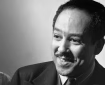
The Civil Rights movement of the 1950s, 1960s, and early 1970s has been recognized globally as the most transformative social movement of twentieth-century America. Likewise, the Black Power movement that grew out of it in the 1960s is also viewed… Read More ›
-
Science Fiction

Though writers and scholars disagree on the precise boundaries of the Golden Age of science fiction and the New Wave, both are associated with the years after World War II. In his anthology Before the Golden Age, Isaac Asimov dates… Read More ›
-
Postmodernist Fiction

American literary Postmodernism flourished in the period after World War II, though most critics place its inception in the late fifties and early sixties. It was a reaction to the times: the end of World War II, Hiroshima and the… Read More ›
-
The Counter Culture and Literature

For Theodore Roszak, who coined the term in his 1969 study The Making of a Counter Culture, the counter culture referred to the disaffected youth of the 1960s whose interests “in the psychology of alienation, oriental mysticism, psychedelic drugs, and… Read More ›
-
Popular Music as Literature

In the preface to Beowulf to Beatles: Approaches to Poetry (1972) David R. Pichaske writes, “Laughter and unqualified ridicule are the usual reactions within the halls of academia to any mention of rock and roll lyrics as poetry.” Pichaske’s conviction… Read More ›
-
Confessional Poetry
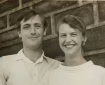
Critic M. L. Rosenthal coined the term “confessional poetry” in his review of Robert Lowell’s Life Studies (1959) in the 19 September 1959 issue of The Nation, noting that while most poets conceal themselves, “Lowell removes the mask.” The term… Read More ›
-
The Cold War and Literature
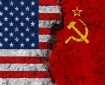
At the end of World War II, the United States and the Soviet Union emerged as the most powerful and influential countries in the world. Although they were allied against the Axis powers during the war, deeply rooted ideological differences… Read More ›
-
Literature and the Environment

Nature and the environment are traditional themes in American literature and have a long history on the North American continent. Native American oral narratives invoke plant and animal life, weather patterns, and particular places, often viewing these elements of the… Read More ›
You must be logged in to post a comment.