Recent Posts - page 7
-
Analysis of Else Lasker-Schüler’s Say It Softly

Published in her volume My Miracles, Leise Sagen (“Say It Softly—”) embodies Lasker-Schüler’s greatest expressionist achievements. She combines extraordinary, unconventional imagery with simplicity of form to render love as both spirited frisson and melancholic surrender. The title, along with its… Read More ›
-
Analysis of Agostinho Neto’s Saturday in the Sand-Slums

This poignant and painful poem, one of Agostinho Neto’s longest, documents in stark detail the conditions of life for poor Africans in the shantytowns surrounding Angola’s capital city, Luanda. The poem Sabado nos musseques expresses the anxieties experienced by the… Read More ›
-
Analysis of Paul Claudel’s The Satin Slipper

The Satin Slipper (Le Soulier de satin), subtitled “The Worst is Not the Surest,” is an epic verse drama by French poet, dramatist, and diplomat Paul Claudel. He began writing the play after a diplomatic assignment in Brazil in 1918… Read More ›
-
Analysis of Georg Trakl’s A Romance to Night

A Romance to Night (Romanze zur Nacht) is a perfect example of Trakl’s preoccupation with the horrors of modernity in rural settings and its effects on the individual’s physical and unconscious existence. It showcases Trakl’s most characteristic poetic technique of… Read More ›
-
Analysis of Dennis Brutus’s Robben Island Sequence

One of many poems by Dennis Brutus reflecting on the prison experience, Robben Island Sequence is fairly typical of the poet’s later work, in which Brutus sought to eliminate the tight verse structure and ornate diction of his earlier work… Read More ›
-
Analysis of Tamura Ryūichi’s Research into Fear

During the 1960s, Tamura Ryūichi published two poems as separate, exceptionally slim volumes. One was Research into Fear (or A Study of Fear, 1963); the other was Decaying Matter (or A Perishable Substance, 1966). One of Tamura’s translators commented: “In… Read More ›
-
Analysis of Anna Akhmatova’s Requiem

Anna Akhmatova’s stunning song for the dead was written in stages, most of it between 1935 and 1940, with the epigram and opening movement added two decades later. As with her other poems that could invoke the wrath of the… Read More ›
-
Analysis of Jayanta Mahapatra’s Relationship
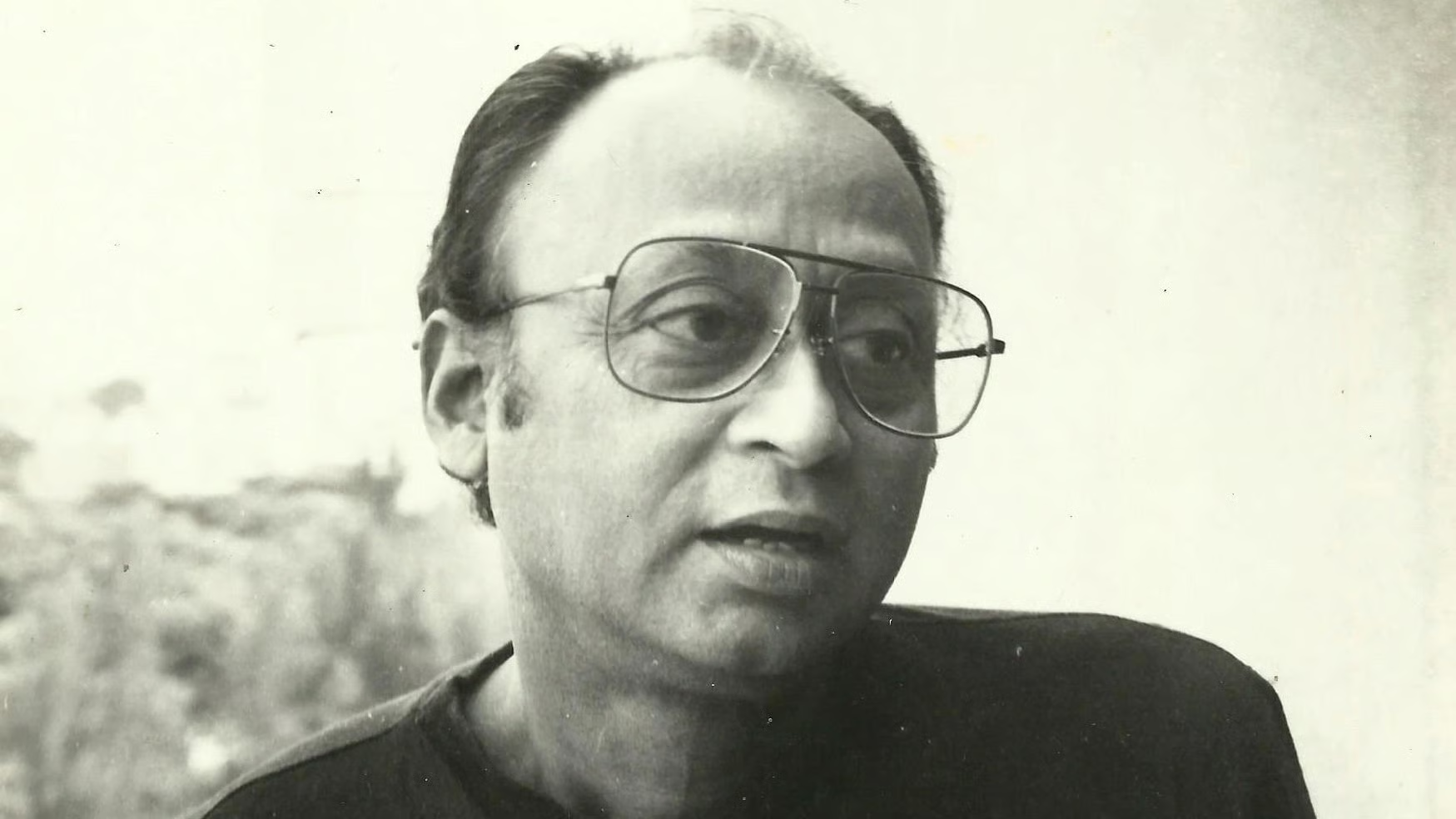
Originally published in New York by the Greenfield Review Press in 1980, Relationship is a visionary poem of 673 lines divided into 12 sections, incorporating Mahapatra’s ambitious attempt to inscribe his Oriya roots and ancestry in a song that weaves… Read More ›
-
Analysis of Novica Tadić’s The Red Locust

Novica Tadić’s The Red Locust is a key representative poem from this Montenegran (Yugoslavian) poet’s seminal 1981 collection Ždrelo (Maw). This poem has a majority of the hallmarks found in the poet’s oeuvre. The poem, much like the collection from… Read More ›
-
Analysis of Gabriele D’Annunzio’s Rain in the Pinewood

This is probably the most widely known of D’Annunzio’s poems and the one that is usually taken as most emblematic of his “panism,” the ability to experience the vibrant life of nature in one’s own body and soul. The poem… Read More ›
-
Analysis of Imtiaz Dharker’s Purdah, 1

PURDAH (1) One day they said she was old enough to learn some shame. She found it came quite naturally. Purdah is a kind of safety. The body finds a place to hide. The cloth fans out against the skin… Read More ›
-
Analysis of Blaise Cendrars’s The Prose of the Trans-Siberian and the Little Joan of France

La Prose du Transsibérien et de la Petite Jehanne de France (The Prose of the Trans-Siberian and the Little Joan of France), published in Paris in September 1913, is in many respects a foundational text for modernism in literature and… Read More ›
-
Analysis of Kahlil Gibran’s The Prophet

The Prophet, a book of 26 poetic essays, has been translated into over 20 languages, has had 45 editions in America alone, and is Kahlil Gibran’s best-known work. In spite of its popular success, the book has received little critical… Read More ›
-
Analysis of Aimé Césaire’s Prophecy

Like much of Aimé Césaire’s poetry, Prophecy possesses a stream-of-consciousness style in unrhymed, free verse with lines of varying length. The poet reminisces about Caribbean islands before European colonization, the fecundity of their vegetation, and the wonders of the animal… Read More ›
-
Analysis of Chinweizu’s Professor Derrida Eshu

As a student of American literature and culture at the State University of New York (Buffalo) during the mid- and late 1970s, Chinweizu encountered the writings of Jacques Derrida, the father of deconstructionist literary criticism, because Derrida was making a… Read More ›
-
Analysis of Miyazawa Kenji’s Proem: The Hard Keyura Jewels

Miyazawa wrote his Proem poem The Hard Keyura Jewels… (1922) as a supplement to his first collection, Spring and Asura (1924). While the first two lines or so of the manuscript seem to be missing, the poem clearly expresses the… Read More ›
-
Analysis of Yevgeny Yevtushenko’s Pre-Morning

Pre-Morning (Predutro) is the title poem of Yevgeny Yevtushenko’s first book of poetry published after his Collected Poems in 1991. The 11 quatrains that make up the poem are set in a liminal time, when the day is coming into… Read More ›
-
Analysis of René Depestre’s Prelude

Prelude (Prélude) is the first poem in René Depestre’s best-known collection, A Rainbow for the Christian West (Un arc-en-ciel pour l’occident chrétien, 1967). It is written in unrhymed free verse and divided into four parts, the last of which is… Read More ›
-
Analysis of Karin Boye’s Prayer to the Sun

This poem, Bön till solen, appeared in Karin Boye’s fourth and final collection of poetry, För trädets skull (For the Tree’s Sake, 1935). (A fifth collection, De sjudödssynderna [The Seven Deadly Sins], was published posthumously in 1941.) This poem is… Read More ›
-
Analysis of Jorge Guillén’s The Power of Pérez

Potencia de Pérez (The Power of Pérez) was published in Maremágnum (1957), a collection of poems that is part of Clamor. Jorge Guillén’s attitude toward the world is less positive in Clamor than in Cántico. The recurring topic is contemporary… Read More ›
You must be logged in to post a comment.