The Civil Rights movement of the 1950s, 1960s, and early 1970s has been recognized globally as the most transformative social movement of twentieth-century America. Likewise, the Black Power movement that grew out of it in the 1960s is also viewed as having a significant impact on race relations in the United States. Although both movements shared a goal to liberate black Americans from centuries-old institutionalized and socially sanctioned discrimination and racism, they had complex and differing views on integration and self-defense. Simply put, most proponents of civil rights were pro-integration and determinedly non-violent, while the majority of black-power activists did not view integration as a prerequisite for black liberation and had no qualms about violence for the purpose of self-defense.
Students should bear in mind that there is no consensus on a timeline for the Civil Rights movement or Black Power era. Demands for civil and human rights in America can be found in various forms in every decade stretching back to the seventeenth century, when captured Africans were brought to the United States, but the seeds of the contemporary movement were firmly planted during the post–World War II years. Jackie Robinson’s successful attempt to integrate Major League Baseball became a hallmark of the 1940s and of contemporary civil-rights efforts in general. In addition, sit-ins and other forms of nonviolent protest that came to symbolize the modern-day Civil Rights movement date back to at least 1943 when the Congress of Racial Equality (CORE) held a sit-in at a lunch counter in Chicago.
In 1951, three years before the Supreme Court deemed segregated public educational facilities unconstitutional in the landmark case of Brown v. Board of Education, Barbara Johns, a sixteen-year-old Virginia high-school student, spearheaded a student protest against segregated schools. The Brown decision itself had roots in the Mendez v. Westminster case of 1946. Debate continues over the accurate starting points of the Civil Rights and Black Power movements, and many scholars view both movements as ongoing.
A few of the key historical moments, in addition to issues such as housing, employment, and discrimination, that inspired creative responses are as follows, and writers responded to each of them through poetry, fiction, drama, and nonfiction. The following list of pivotal events draws upon Jeffrey Lamar Coleman’s anthology Words of Protest, Words of Freedom: Poetry of the American Civil Rights Movement and Era (Duke University Press, 2012), an essential collection that documents the literary voices of this transformative period:
- The murder of Emmett Till in Money, Mississippi, 1955
- The Montgomery, Alabama, bus boycott, 1955–1956
- The Little Rock, Arkansas, school desegregation, 1957–1958
- The lynching of Mack Charles Parker in Poplarville, Mississippi, 1959
- The assassination of Medgar Evers in Jackson, Mississippi, 1963
- The Sixteenth Street Baptist Church bombing in Birmingham, Alabama, 1963
- The murders of civil-rights organizers James Chaney, Andrew Goodman, and Michael Schwerner in Philadelphia, Mississippi, 1964
- The assassination of Malcolm X in New York City, 1965
- The Selma to Montgomery, Alabama, Voting Rights March, 1965
- The birth (and legacy) of the Black Panther Party, 1966
- The assassination of Dr. Martin Luther King Jr. in Memphis, Tennessee, 1968
While it is impossible to treat the full extent of the literary responses to these issues concisely, students and researchers will find Coleman’s anthology an invaluable resource for exploring representative works inspired by these defining moments. As Grace Cavalieri noted in her review for the Washington Independent Review of Books, “Editor Jeffrey Lamar Coleman has combined scholarship with art. There are 14 sections to the book and each is preceded by an essay as educational scaffolding for the poems. Each essay, a small exegesis of history, describes how the poems relate. It’s a masterwork of organization and strategy. Not only African American poets are represented here, the editor points out, and the 82 poets make up a roster that could fill any poetry hall of fame. Some are dead, some venerable, some unknown, but the poems are each honored with context and framework.”
The murder of fourteen-year-old Emmett Till in August 1955 for allegedly flirting with a married white woman in Mississippi galvanized civil-rights organizers and inspired writers as well. The poet Gwendolyn Brooks conveyed her disgust with the murder and subsequent trial in a seemingly restrained, indirect manner in “A Bronzeville Mother Loiters in Mississippi. Meanwhile, a Mississippi Mother Burns Bacon” (1960). Brooks focused on the interior and domestic life of Carolyn Bryant, the woman Till was accused of flirting with, instead of Till’s murder. Furthermore, the violence described in the poem is initiated by Carolyn’s husband, Roy, one of the men responsible for Till’s death, and it is directed at his wife and children instead of Till. Brooks’s aesthetic approach reveals Roy Bryant’s propensity for anger, even toward his own family.
The poem “Mississippi 1955” (1955) by Langston Hughes is one of the first poems of the era to broach the subject of terror literally. The poem calls attention to mid-twentieth-century American terrorism, the kind visited upon African Americans and white sympathizers by racist organizations and civilians. This form of terror ranged from lynchings and bombings to attempts to cripple civil-rights advocates economically, psychologically, and spiritually.
The play Blues for Mister Charlie (1964), by James Baldwin, is heavily influenced by and based loosely on the Till murder. The play explores reactions to a similar tragedy from the perspectives of “White Town” and “Black Town.”
A few months after Till’s murder, Rosa Parks refused to give up her seat on a Montgomery, Alabama, bus, sparking a boycott that lasted more than a year. Dr. Martin Luther King Jr. responded to the boycott and its subsequent victory with his collection of nonfiction essays, Stride Toward Freedom: The Montgomery Story, in 1958.
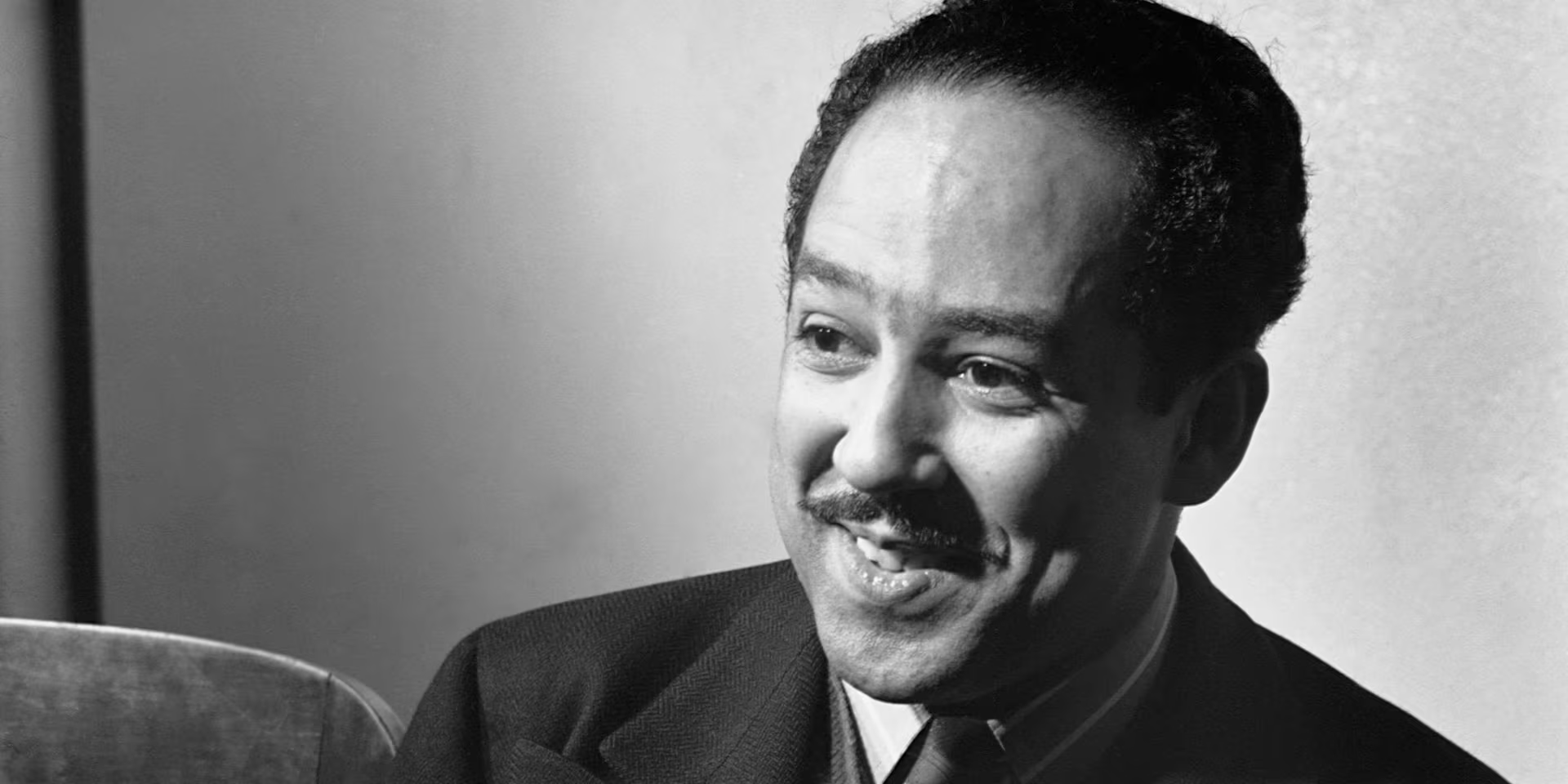
Langston Hughes/Corbis via Getty Images
In 1959 Lorraine Hansberry’s now-classic play A Raisin in the Sun was produced; it was the first drama written by a black woman to appear on Broadway. The play centers on an African American family in Chicago and deals primarily with family heritage, capitalism, racism, and housing discrimination. Similarly, it provides an illustration of the difficulties of integration, conveying the idea that the burden of integration falls squarely on the shoulders of the black community. A Raisin in the Sun was awarded a New York Drama Critics’ Circle Award and is considered a groundbreaking work of American theater.
The struggle for integration, and the opposition to it, also played a significant role in the 1963 assassination of Medgar Evers, who in 1954 became the first field secretary of the NAACP in Mississippi and was one of the state’s most visible and active civil-rights leaders. Evers was instrumental in the campaign to register James Meredith as the first black student at the University of Mississippi at Oxford in 1962. Eventually, Evers became a dominant force for the rights of blacks in one of the country’s most hostile and racially divided states.
Among the poems that eulogized Evers after he was murdered in his driveway were Aaron Kramer’s “Blues for Medgar Evers” (1964), David Ignatow’s “For Medgar Evers” (1968), and Margaret Walker’s “Micah” (1970). The Southern fiction writer Eudora Welty also used Evers’s life and death as inspiration in her short story “Where is the Voice Coming From” (1963).
Also in 1963 Baldwin released The Fire Next Time, a collection of two short personal essays that addressed America’s racial crisis, particularly white America’s denial of past and present racial abuses. Baldwin warned that if Americans, black and white, cannot come together like “lovers” to bridge the racial divide, unrest will result in violence and destruction. He proved to be prophetic: racially charged riots later erupted in Harlem (1964), Watts (1965), and Newark and Detroit (1967). In addition, the Orangeburg Massacre occurred in South Carolina in 1968 when student attempts to enter a segregated bowling alley resulted in a riot that left three dead and twenty-eight injured. That same year hundreds of American cities devolved into chaos after the assassination of King.
In 1964 LeRoi Jones (later Amiri Baraka) produced the controversial one-act play Dutchman, which addressed subjects that were at the time considered taboo, such as interracial sexual desire, black middle-class identity, and violent attacks on educated black males. Dutchman won an Obie Award for best off-Broadway play.
The following year Malcolm X and Alex Haley published The Autobiography of Malcolm X (1965), addressing a range of personal and social issues, especially issues involving race relations and religion. Malcolm X was gunned down the same year by members of the Nation of Islam, a religious sect from which he had recently distanced himself. His life was remembered in poems such as Quincy Troupe’s “For Malcolm Who Walks in the Eyes of Our Children” (1968), Baraka’s “A Poem for Black Hearts” (1969), Sonia Sanchez’s “malcolm” (1969), and Robert Hayden’s “El-Hajj: Malik El-Shabazz” (1970). Dudley Randall, founder of Broadside Press, published the anthology For Malcolm: Poems on the Life and Death of Malcolm X (1967).
The assassination of King, the leader of America’s nonviolent Civil Rights struggle, on 4 April 1968, spawned a wealth of poetic responses. Among the numerous elegies written for King were Haki Madhubuti’s “Assassination” (1968), Brooks’s “Riot” (1969), Lucille Clifton’s “the meeting after the savior gone” (1969), Robert Lowell’s “Two Walls” (1969), and Nikki Giovanni’s “Reflections on April 4, 1968” (1970).
Topics for Discussion and Research
- Literary responses to social movements often produce a certain amount of anxiety for writers. For example, a writer must decide how to address a given topic, such as the assassination of an inspirational leader or the murder of an ordinary citizen, as artistically as possible, without becoming trite or melodramatic. Based on a few of the responses provided above, such as works written about Till, Evers, or King, how well have writers handled this task? How do they manage to address difficult emotional subjects in their writing? Do they, in turn, employ emotional language or aesthetics, or do they somehow distance themselves in some manner in order to address their topic? Which approach works best and why?
- Creative responses to historical events present additional challenges as well. For example, a literary response strives to be more than a “blow-by-blow” account of the historical material, an approach better left to journalists and historians. Creative responses, which may be closely or loosely based on the facts of the events, aim to enhance a reader’s understanding of the event intellectually and/or emotionally. Baldwin’s Blues for Mister Charlie, for example, is loosely based on the murder of Till. How does the playwright honor Till while altering the facts of the case? How does the play, despite its historical inaccuracies, enhance a reader’s comprehension of the crime?
- After reading a chapter in Voices of Freedom, an oral-history account of the Civil Rights movement, in conjunction with a creative response, students might explore the relationship between an oral account based on personal experience and a creative response that is not required to be historically accurate. How do these pieces differ in their respective abilities to relay history to readers? For example, how do oral histories of Evers mesh with poems written in his honor? Neither account may be historically reliable, considering how faulty memories can plague oral accounts of historical moments, but both should be historically grounded and should elucidate the historical moment in some way for readers. How is this task accomplished from both creative and oral history perspectives?
- Religion played an extremely significant role in both the Civil Rights and Black Power movements, with the former inspired by Christian theology and the latter by Islamic teachings. How are these influences represented in literary responses? For example, what role does religion play in Baldwin’s The Fire Next Time? How does he view the two religions? Also, how does religion inform Hansberry’s A Raisin in the Sun or Jones’s Dutchman? Can Hansberry’s play be considered pro-Christian? Why does Jones invoke Adam and Eve? Likewise, how does religion contribute to poems written for King and Malcolm X? Is religion viewed in a negative light in any of the responses? If so, how does this perspective contribute to the work’s overall message?
- After reading Jones’s Dutchman students might analyze the significance of its ending. What is the play attempting to say about educated black males in American society by way of Lula’s actions? To what extent does the play’s message concerning black males apply to contemporary society?
Resources
Biography
Henry Hampton and Steve Fayer, Voices of Freedom: An Oral History of the Civil Rights Movement from the 1950s through the 1980s (New York: Bantam, 1990).
Oral histories that track the major moments of the Civil Rights era.
Criticism
Regina Jennings, “Poetry of the Black Panther Party: Metaphors of Militancy,” Journal of Black Studies, 29 (September 1998): 106–129.
Critical examination of the poetry, history, and rhetoric found in the organization’s newspaper.
Eugene Redmond, Drumvoices: The Mission of Afro-American Poetry, A Critical History (Garden City, N.Y.: Anchor Press, 1976).
Critical introduction and historical overview of black poetry, ending with works produced in the 1960s and 1970s.
James Edward Smethurst, The Black Arts Movement: Literary Nationalism in the 1960s and 1970s (Chapel Hill: University of North Carolina Press, 2005).
Explores Black Power–era literature from historical and sociological perspectives.
Angelyn Mitchell, Within the Circle: An Anthology of African American Literary Criticism from the Harlem Renaissance to the Present (Durham, N.C.: Duke University Press, 1994).
Collection of critical essays that helps place civil-rights and black-power literature within the continuum of African American literature.
Categories: Literature
 Analysis of Nathaniel Hawthorne’s The Blithedale Romance
  Analysis of Rudolfo Anaya’s Bless Me, Última
  Analysis of Gertrude Atherton’s Black Oxen
  Analysis of Richard Wright’s Black Boy
You must be logged in to post a comment.