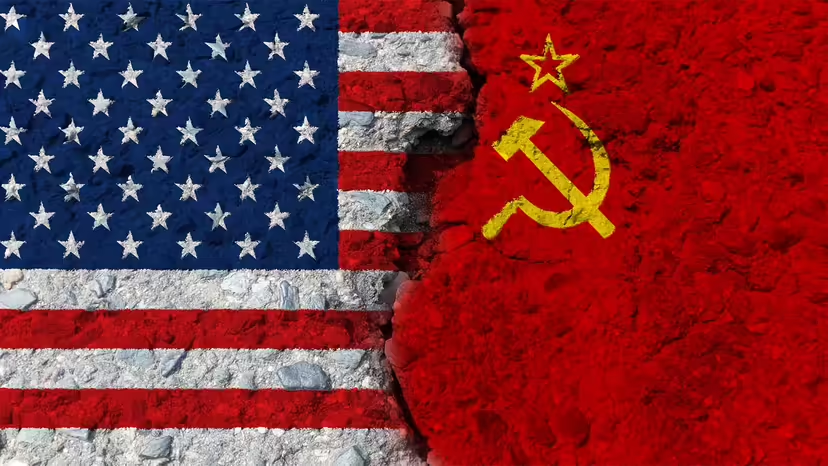
At the end of World War II, the United States and the Soviet Union emerged as the most powerful and influential countries in the world. Although they were allied against the Axis powers during the war, deeply rooted ideological differences and conflicting visions for the reconstruction of Europe and the rest of the world ultimately divided the superpowers and led to an era of severe global tension known as the Cold War.
Although there are no exact beginning and ending dates for the Cold War, many historians date the beginning to 1945, at the conclusion of World War II, and the ending to 1991, when Mikhail Gorbachev resigned as Soviet president and abolished the Soviet Union. Pitted against one another during the Cold War, the United States and its Western counterparts stood for democracy and representative government, while the Soviet Union and its counterparts stood for communism and the totalitarian state. The period after World War II was dominated by fierce competition for superiority between the two nations that involved a struggle for political, technological, and martial dominance on both a localized and a worldwide scale.
There are six main themes through which American literature responds to and engages with the Cold War: containment culture and the containment narrative; McCarthyism and anticommunism; widespread paranoia; conformity and the consensus culture; the rise of consumerism; and countercultural rebellion.
When thinking about the Cold War and literature, many scholars have examined the “containment” policy that dominated American foreign policy during the era. Containment was an idea initially articulated as a U.S. government foreign-policy initiative for containing the threat of Soviet communism. Containment policy originated in 1947 with U.S. diplomat George F. Kennan, who argued for the containment of communist influence on the grounds of the Soviet Union’s inherently dangerous expansionist tendencies.
Cultural and literary scholar Alan Nadel’s 1995 book Containment Culture details what he perceives as Cold War literature’s exemplification of containment. Nadel employs J.D. Salinger’s The Catcher in the Rye (1951) as a text whose narrator, Holden Caulfield, he believes overtly expresses the attitudes of containment in his need to expose “phonies.” Holden’s need to weed out phonies, Nadel argues, parallels the compulsive attempts during the 1940s and 1950s of the House Committee on Un-American Activities (HCUA) and U.S. Senator Joseph McCarthy to expose Americans posing as patriots while potentially harboring communist sympathies.
Senator McCarthy’s anticommunist campaign signified the full transformation of containment policy into the domestic realm. The idea that communists and Soviet spies were living in the United States and employed in government positions struck fear into the American people and set the stage for the infamous HCUA hearings in which people, notably literary and motion-picture celebrities, were investigated on the basis of their alleged association with communism.
Arthur Miller’s 1953 play The Crucible allegorically represents, through the lens of the Salem witch trials of 1692, the congressional hearings and the subsequent effect on those accused of being communists, often on the basis of hearsay evidence. In Miller’s play, accusations of witchcraft and general hysteria sweep colonial Massachusetts and chillingly mirror the widespread panic over communism that swept America in the 1950s. Miller was himself called to testify before the HCUA in 1956.
Novelist Mary McCarthy presents a more lighthearted and satirical investigation of McCarthyism’s effects in The Groves of Academe (1951). The novel focuses on the dismissal of Professor Henry Mulcahy and the attempt to uncover the true reason for his dismissal. Mulcahy’s fitness to teach is reduced to a determination of whether he was ever a communist—grounds that were not uncommon for dismissal from important positions in the 1950s.
Even after McCarthy was discredited in 1954, the American public was left with an unsettling feeling of paranoia and fear. McCarthyites exaggerated the extent of the communist threat and demonstrated the American government’s less-than-democratic methods of addressing possible communist infiltration. Some equated government practices during the height of McCarthyism with the tyranny of communism.
In The Crying of Lot 49 (1966), Thomas Pynchon reflects on paranoia, conspiracy, and dislocation as legitimate reactions to a world gone awry. The novel’s protagonist, Oedipa Maas, finds herself enmeshed in what appears to be a worldwide conspiracy that relates to the death and estate of her former boyfriend, Pierce Inverarity. The novel’s distinctly American landscape and paranoid complexity take Cold War anxieties to such an extreme that most perceptions remain elusive, uncertain, and worthy of suspicion.
Many scholars who read Cold War literature as engaged with containment policy, McCarthyism, and paranoia also interpret the culture and literature of the Cold War as expressly concerned with consensus and conformity. If rooting out and containing communism was a cause every loyal American should support, then it followed that a “consensus culture” would evolve as an expression of patriotism.
Critics have read many Cold War texts as upholding this established consensus—one of the most significant being Sloan Wilson’s The Man in the Gray Flannel Suit (1955). Wilson imagines consensus culture within the spheres of business and family. The novel’s protagonist, Tom Rath, appears to readily place the needs of family, corporation, and country over his individual aspirations, becoming an iconic representation of mainstream Cold War sentiments.
The theme of consumerism functions as an extension of conformity and the consensus culture. Consumerism refers to the excessive consumption of material goods as a means for attaining happiness and success. During the Cold War, consumerism stimulated the American economy in hopes of maintaining supremacy over the Soviet Union.
While much of the consensus culture subscribed to consumerism, some writers reacted strongly against it. In Lolita (1955), Vladimir Nabokov, a Russian-born immigrant, details the journey of an aristocratic European pedophile across America with twelve-year-old Lolita. Setting aside the moral outrage, readers notice a penetrating satire of Cold War consumerism: Humbert Humbert, the main character, repels against Lolita’s fascination with consumer goods and uses material gifts to manipulate her. Nabokov also critiques the gaudy advertisements that promoted unnecessary products as necessities for Americans.
A troubling but artistically inspiring condition of the Cold War in the United States was its simultaneous ideological emphasis on individual freedom and patriotic loyalty. Allen Ginsberg captures this conflict in his 1956 poem America, informing the nation, “I am sick of your insane demands.” Literary themes such as identity search, coming of age, and individual assertion took on new dimensions as Cold War ideologies clashed.
The three canonical male Beat writers—Ginsberg, Jack Kerouac, and William S. Burroughs—repudiated mass movements such as containment, consensus, and consumerism. If mainstream America was a consensus culture, the Beat Generation was an anticonsensus movement, rejecting Cold War society’s prevailing interests.
In Howl (1956) and America, Ginsberg laments Cold War conformity and draws attention to dislocated and marginalized figures. In Junkie (1953), Burroughs depicts a heroin-addicted character who represents a side of America absent from mainstream portrayals. Kerouac’s On the Road (1957) features Sal Paradise, who rejects consumerism and conformity, setting out “on the road” to find an America he can identify with as a free-spirited individual.
In Ralph Ellison’s Invisible Man (1952), the unnamed narrator joins “The Brotherhood,” a proxy for the Communist Party. Initially attracted by promises of equality, he later realizes he is being used to rally African American support. Unable to reconcile his individuality with the collective, he ultimately rejects both communism and America’s institutional racism, choosing to live underground—a powerful symbol of alienation.
Topics for Discussion and Research
- After reading The Catcher in the Rye, students might read Nadel’s essay on containment policy in Harold Bloom’s Holden Caulfield (Philadelphia: Chelsea House, 1990). Students could analyze Nadel’s reading and argue whether his evidence supports his argument. They might also apply Nadel’s containment-narrative methodology to The Crucible or other 1950s literature.
- Many Cold War-era movies used metaphor, symbol, and allegory to address fears of communist infiltration. Students could view Them! (1954), Kiss Me Deadly (1955), Invasion of the Body Snatchers (1956), and The Mouse That Roared (1959) to trace these devices.
- Beat writers distanced themselves from mainstream American society, criticizing consumerism and culture. After studying Ginsberg’s America or Howl, students might debate whether Ginsberg could be seen as a patriot, extending the discussion to other Beat writers.
- Using Ellison’s depiction of “The Brotherhood” in Invisible Man as a proxy for the real-world Communist Party, students could analyze how Ellison critiques communist blindness to race, referencing Jesse Wolfe’s essay “‘Ambivalent Man’: Ellison’s Rejection of Communism” (African American Review, 34, 4, 2000).
- Although the 1960s are often cited as the beginning of counter-cultural and activist movements, their roots reach back to the 1950s. Students might examine works by Kerouac, Burroughs, or Ellison for early signs of counter-culture and social activism.
Resources
Criticism
- Paul S. Boyer, By the Bomb’s Early Light: American Thought and Culture at the Dawn of the Atomic Age (Chapel Hill: University of North Carolina Press, 1994).
- Douglas Field, ed., American Cold War Culture (Edinburgh: University of Edinburgh Press, 2005).
- Joel Foreman, The Other Fifties: Interrogating Mid-century American Icons (Urbana: University of Illinois Press, 1997).
- Christina Klein, Cold War Orientalism: Asia in the Middlebrow Imagination, 1945–1961 (Berkeley: University of California Press, 2003).
- Peter Knight, Conspiracy Nation: The Politics of Paranoia in Postwar America (New York: New York University Press, 2002).
- Elaine Tyler May, Homeward Bound: American Families in the Cold War Era (New York: Basic Books, 1988).
- Lary May, ed., Recasting America: Culture and Politics in the Age of Cold War (Chicago: University of Chicago Press, 1989).
- Leerom Medovoi, Rebels: Youth and the Cold War Origins of Identity (Durham, N.C.: Duke University Press, 2005).
- Alan Nadel, Containment Culture: American Narratives, Postmodernism, and the Atomic Age (Durham, N.C.: Duke University Press, 1995).
- Thomas H. Schaub, American Fiction in the Cold War (Madison: University of Wisconsin Press, 1991).
- Ellen Schrecker, Many Are the Crimes: McCarthyism in America (Princeton: Princeton University Press, 1998).
- Stephen Whitfield, The Culture of the Cold War (Baltimore: Johns Hopkins University Press, 1996).
Categories: Literature
 Analysis of Nathaniel Hawthorne’s The Blithedale Romance
  Analysis of Rudolfo Anaya’s Bless Me, Última
  Analysis of Gertrude Atherton’s Black Oxen
  Analysis of Richard Wright’s Black Boy
You must be logged in to post a comment.