Giuseppe Ungaretti’s Shout No More Stop killing the dead, don’t shout anymore, don’t shout if you still want to hear them, if you hope not to pass on. They have the imperceivable murmur, they make no more noise than the… Read More ›

Giuseppe Ungaretti’s Shout No More Stop killing the dead, don’t shout anymore, don’t shout if you still want to hear them, if you hope not to pass on. They have the imperceivable murmur, they make no more noise than the… Read More ›

This is the first of seven poems grouped under the heading Sogni di terre lontane (Dreams of Distant Places), which are part of d’Annunzio’s poetic masterpiece Alcyone (Halcyon). If the entire work is a passionate celebration of the summer and… Read More ›

Among many cultures, the powers of seduction and destruction are sides of the same coin. In Sexual Water, from the second volume of Residencia en la Tierra (Residence on Earth), Pablo Neruda imbues the force of water with an erotic,… Read More ›
Self-Portrait is a poem published in Yun Dong-ju’s only collection of poetry, The Sky, the Wind, the Stars and Poetry. This collection, published after his death in 1948, includes 12 poems found posthumously as well as 19 poems he had… Read More ›

An early poem, Segregation represents Peruvian Carlos Germán Belli’s role as a nexus among the Latin American avant-gardes, the poetry of social concerns, and his own later, formally complex neoclassical verse. Belli uses short arte menor verses (fewer than eight… Read More ›

This poem forms the central piece of George’s last volume, Das neue Reich (The Kingdom Come, 1928), and combines the poet’s central themes: autobiographical recollection, a fierce critique of modern society, the invocation of poetic ancestors and heroes, allusions to… Read More ›

The Scythians is Aleksandr Blok’s last significant poem, composed from and for a particular moment in history. It forms part of the “January Trilogy” of 1918, together with The Twelve and the essay The Intelligentsia and the Revolution. Revolutionary Russia… Read More ›

Joyce Mansour’s first volume of verse, Cris (inarticulate expressions of pain, rage, or surprise; but also, cris de bataille, battle cries), brought her to the immediate attention of France’s literati—in particular to the attention of male surrealists who found in… Read More ›

Published in 1978, Schubertiana, a poem from Tomas Tranströmer’s eighth volume of poems, Sanningsbarriären (Truth Barriers), explores the ways in which music functions as an antidote to the fragmentation that often defines contemporary life. As typically happens in Tranströmer’s work,… Read More ›

This quest poem fuses Derek Walcott’s highly metaphoric style with distinctly Caribbean Creole speech patterns. The narrator, a poet/sailor named Shabine, speaks English Creole, declaring, “Well, when I write / this poem, each phrase go be soaked in salt.” This… Read More ›

Published in her volume My Miracles, Leise Sagen (“Say It Softly—”) embodies Lasker-Schüler’s greatest expressionist achievements. She combines extraordinary, unconventional imagery with simplicity of form to render love as both spirited frisson and melancholic surrender. The title, along with its… Read More ›

This poignant and painful poem, one of Agostinho Neto’s longest, documents in stark detail the conditions of life for poor Africans in the shantytowns surrounding Angola’s capital city, Luanda. The poem Sabado nos musseques expresses the anxieties experienced by the… Read More ›

The Satin Slipper (Le Soulier de satin), subtitled “The Worst is Not the Surest,” is an epic verse drama by French poet, dramatist, and diplomat Paul Claudel. He began writing the play after a diplomatic assignment in Brazil in 1918… Read More ›

A Romance to Night (Romanze zur Nacht) is a perfect example of Trakl’s preoccupation with the horrors of modernity in rural settings and its effects on the individual’s physical and unconscious existence. It showcases Trakl’s most characteristic poetic technique of… Read More ›

One of many poems by Dennis Brutus reflecting on the prison experience, Robben Island Sequence is fairly typical of the poet’s later work, in which Brutus sought to eliminate the tight verse structure and ornate diction of his earlier work… Read More ›

During the 1960s, Tamura Ryūichi published two poems as separate, exceptionally slim volumes. One was Research into Fear (or A Study of Fear, 1963); the other was Decaying Matter (or A Perishable Substance, 1966). One of Tamura’s translators commented: “In… Read More ›

Anna Akhmatova’s stunning song for the dead was written in stages, most of it between 1935 and 1940, with the epigram and opening movement added two decades later. As with her other poems that could invoke the wrath of the… Read More ›
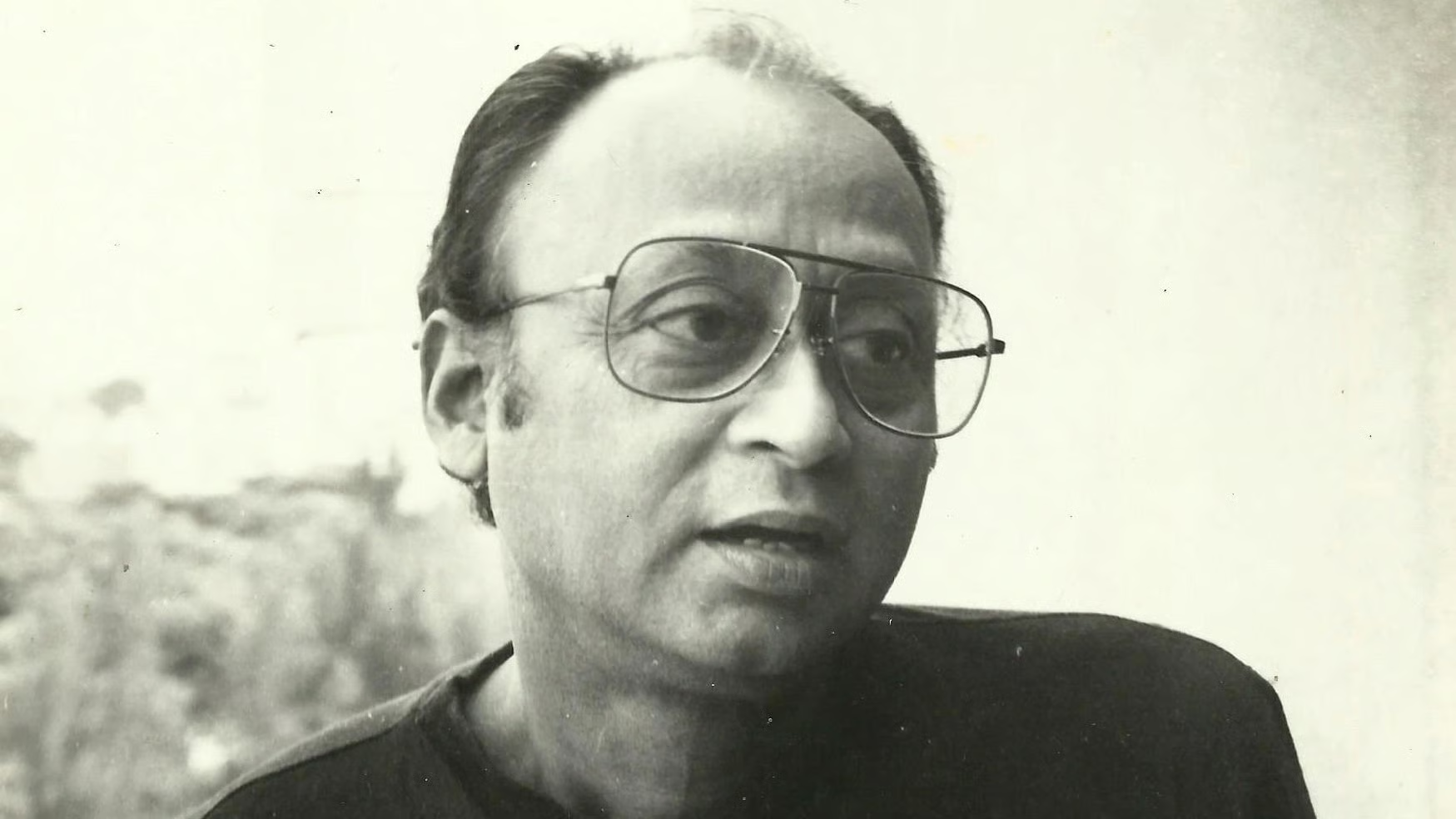
Originally published in New York by the Greenfield Review Press in 1980, Relationship is a visionary poem of 673 lines divided into 12 sections, incorporating Mahapatra’s ambitious attempt to inscribe his Oriya roots and ancestry in a song that weaves… Read More ›

Novica Tadić’s The Red Locust is a key representative poem from this Montenegran (Yugoslavian) poet’s seminal 1981 collection Ždrelo (Maw). This poem has a majority of the hallmarks found in the poet’s oeuvre. The poem, much like the collection from… Read More ›

This is probably the most widely known of D’Annunzio’s poems and the one that is usually taken as most emblematic of his “panism,” the ability to experience the vibrant life of nature in one’s own body and soul. The poem… Read More ›
You must be logged in to post a comment.